MEDIC SOLO 3x Alum applies dtWFA skills on a Mountain Biking trail
From Team MEDIC: The following is an account from a three-time MEDIC alum who was most recently certified in November 2024.
My name is Nathan Beyeler and I coach youth mountain biking in Harrisonburg Virginia. I’ve served as one of our WFA trained coaches for several years. In the 2024 fall season, I had the unfortunate need to put all of my WFA training to use when a youth rider was severely injured.
Towards the end of the evening practice (at 6:50pm), with the sun well setting I received a radio call that a rider had crashed hard on a separate squad from the one I was leading. After passing off responsibility of my squad to other coaches I started to travel to the scene. As I made my way, I was able to remotely assess the criticality of the rider’s injuries by speaking over the radio with the coaches on the scene. After becoming certain the rider had experienced a high mechanism of injury, receiving info that the rider was vomiting, and had head pain, and while conscious was immobile, I immediately triggered the call to local EMTs via 911 through our incident command. At this time I presumed the rider had a severe concussion. As I continued to the scene, I relayed instruction to secure the patient and to keep immobile until I arrived.
Upon arriving on scene (now dark) and finding the patient already in a recovery position, I completed my primary assessment and quickly deduced that the patient had sustained an acute internal abdominal injury. Using my trauma kit shears I cut through his clothing to expose the area of chief complaint revealing surface level trauma but not a life-threatening external bleed. While remaining conscious, the patient continued to vomit and level of consciousness (LOC) was degrading. Through [the] primary and secondary survey [I] received a patient pain response while palpating the lower spine, though the pain was reported in the abdomen. From the secondary survey I quickly assessed that I would not be able to clear the spine and that we would not be able to transport the patient out of the backcountry on our own.
I radioed our incident command to communicate to EMT that we would require fire-rescue for a mobile response and extraction. Within the time of the secondary survey, I was joined by another coach who was also WFA trained. Throughout the process we rigorously documented assessments and vitals monitoring on the SOAP note whilst protecting the patient from cooling environmental conditions (using emergency blankets I carry in my first-aid kit) and from aspiration as was still vomiting. We continued to engage the patient to mitigate degradation of LOC.
Leaving the patient with the other WFA trained coached, I hiked down to meet the EMT and fire rescue members while they hiked up, using that time to relay all relevant patient information via our SOAP note. As a result of my patient / injury summary, the lead EMT triggered life flight while we were still hiking back up to the scene. EMT and fire rescue arrived on scene and took command of patient care. They stabilized the patient, moved the patient to a backboard, and extracted out via trail emergency utility vehicle whilst administrating treatment enroute, ultimately to a waiting ambulance at the trail head, and then to the life flight helicopter in the adjacent town taking off at 9:17pm. The entire event lasted roughly 2 ½ hours but it felt like a lifetime.
He was treated in the region’s pediatric emergency care unit, requiring surgery to repair a severed intestine (the source of the acute abdominal pain). He had also sustained a tear to a knee tendon. I believe the most important decision I made (informed by my MEDIC WFA training) was the quick assessment of the severity of the injury even while I was still enroute to the scene and triggering the emergency response. This saved crucial response time. I truly believe this decision and action (and those following) affected the favorable outcome.
Several weeks after the injury, I was riding down after practice and saw the rider walking up to the trailhead to say hello to the team. The hug says it all.
While this is the most serious event I’ve responded to, it’s far from the only one. Over the past several years I’ve utilized my WFA skills to treat lacerations, broken bones, sprains, heat exhaustion, and concussions in the back country all mountain bike related. In one event, the responding EMT assumed I was also fully EMT trained based on the level of care I had provided and information I conveyed. I’ve also used my skills to respond to anaphylaxis closer to home. I’m beyond thankful for the skills I’ve learned, and I know for sure that those that I have helped in small and big ways are forever grateful. I’m often chided for ‘why do you always carry that large pack with the big first aid kit when you ride?’. I have found though, that when the need arises, I am the one prepared with the training and tools to render aid.
------------------------------------------------------------------------
MEDIC SOLO's head of school Mateo (Matthew) notes, "Huge Kudos and *Thank You* Nathan for this life save, and for the many other times you've been of first aid service in both the back and front country. Also, in this incident, brilliant thinking with passing off continuing care and monitoring to an equal- or higher-trained person, so you could inform the EMTs of everything on their way to the patient, enabling them to treat and get the patient to the hospital even more quickly. You are a pillar of your community, and are why MEDIC SOLO exists and strives to provide the very best possible medical education -- not just a short course which checks a certification checkbox for attendees. Your amazing supplemental note, "In one event, the responding EMT assumed I was also fully EMT trained based on the level of care I had provided and information I conveyed" sustains and fuels our flame to keep innovating and improving our quality of hands-on education. Lastly, considering that on this ride it turned dark and cold unplanned, your story also serves as a reminder to all of the importance of being prepared to stay out longer than one ever anticipates. People may sometimes look at us funny for having a big pack on just a day trip. A backpack is like the seatbelt in a car, hopefully we never need it, we're prepared when we do, and meanwhile the bigger pack gives us a better workout!"
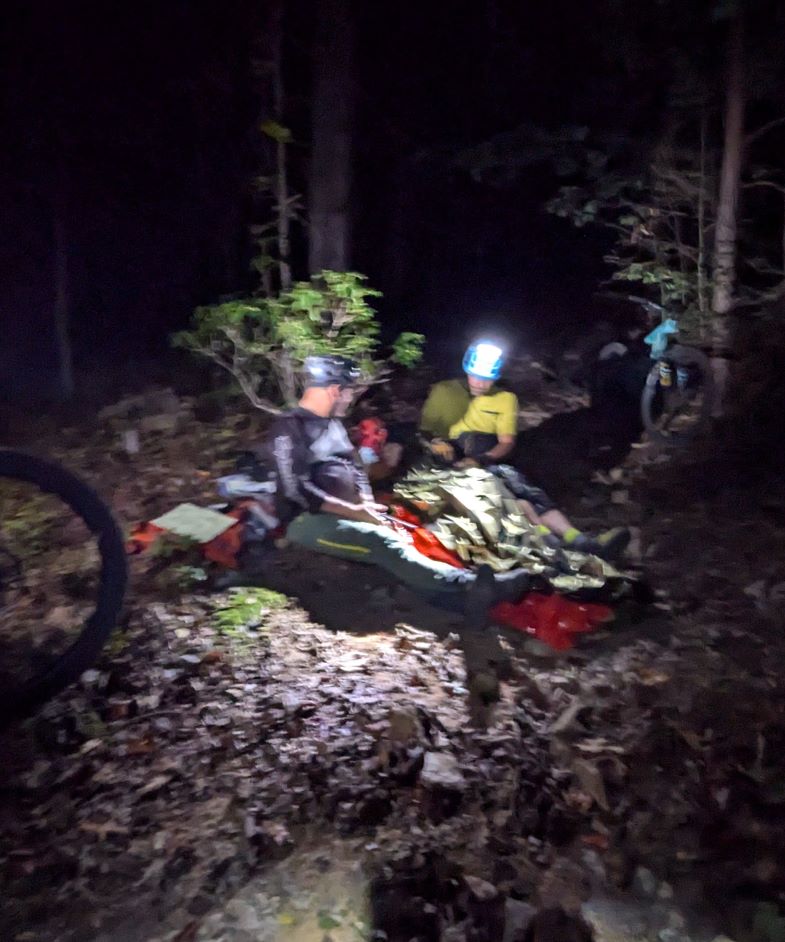
Fellow coaches attending patient, as Nathan Beyeler arrived back on scene with EMT right behind him.
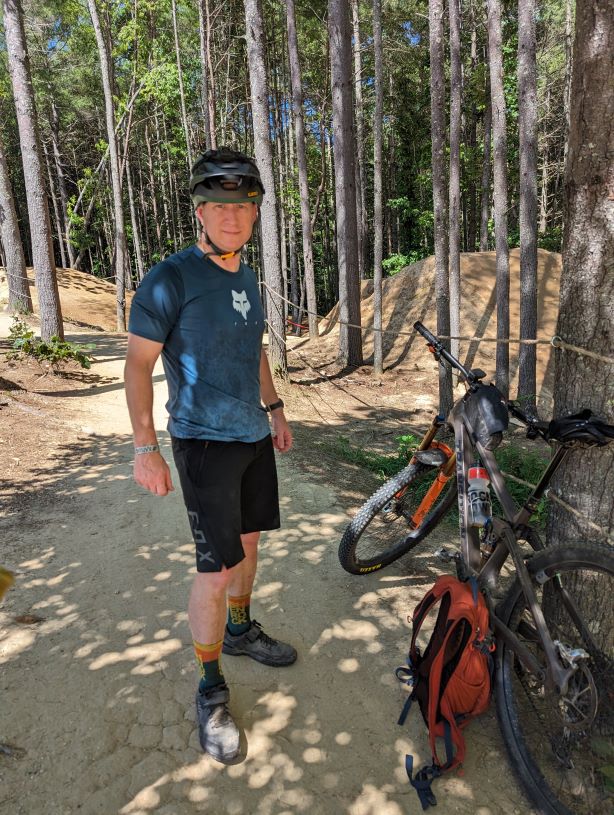
Nathan Beyeler on the trail with the ‘big bag’ he carries, his first aid kit.
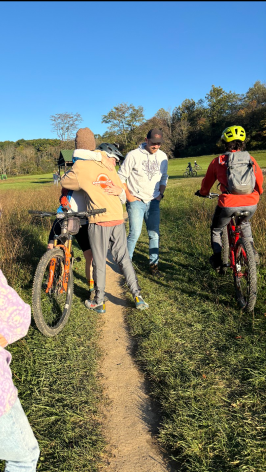
Hug between Nathan Beyeler and the rider, many weeks later. The hug that says it all!